Passing the NGN isn’t about getting every question right—it’s about consistently showing safe clinical judgment. This guide breaks down Next Gen NCLEX scoring, how partial credit is awarded, and the best ways to capture points across item types.
How NGN scoring works (quick overview)
-
Computerized Adaptive Testing (CAT): The test adjusts difficulty based on your responses and estimates your ability (θ).
-
Passing standard: You pass when your ability estimate stays above the standard with enough certainty.
-
Clinical Judgment focus: Many items are polytomous (not just right/wrong), so you can earn partial credit for partially correct clinical decisions.
Goal: make the safest choice at each step—even if you’re unsure—so you keep accumulating points.
Item types & where partial credit appears
1) Case studies (6 linked items)
-
Each case maps to the 6 Clinical Judgment Model (CJM) steps: recognize cues → analyze cues → prioritize hypotheses → generate solutions → take actions → evaluate outcomes.
-
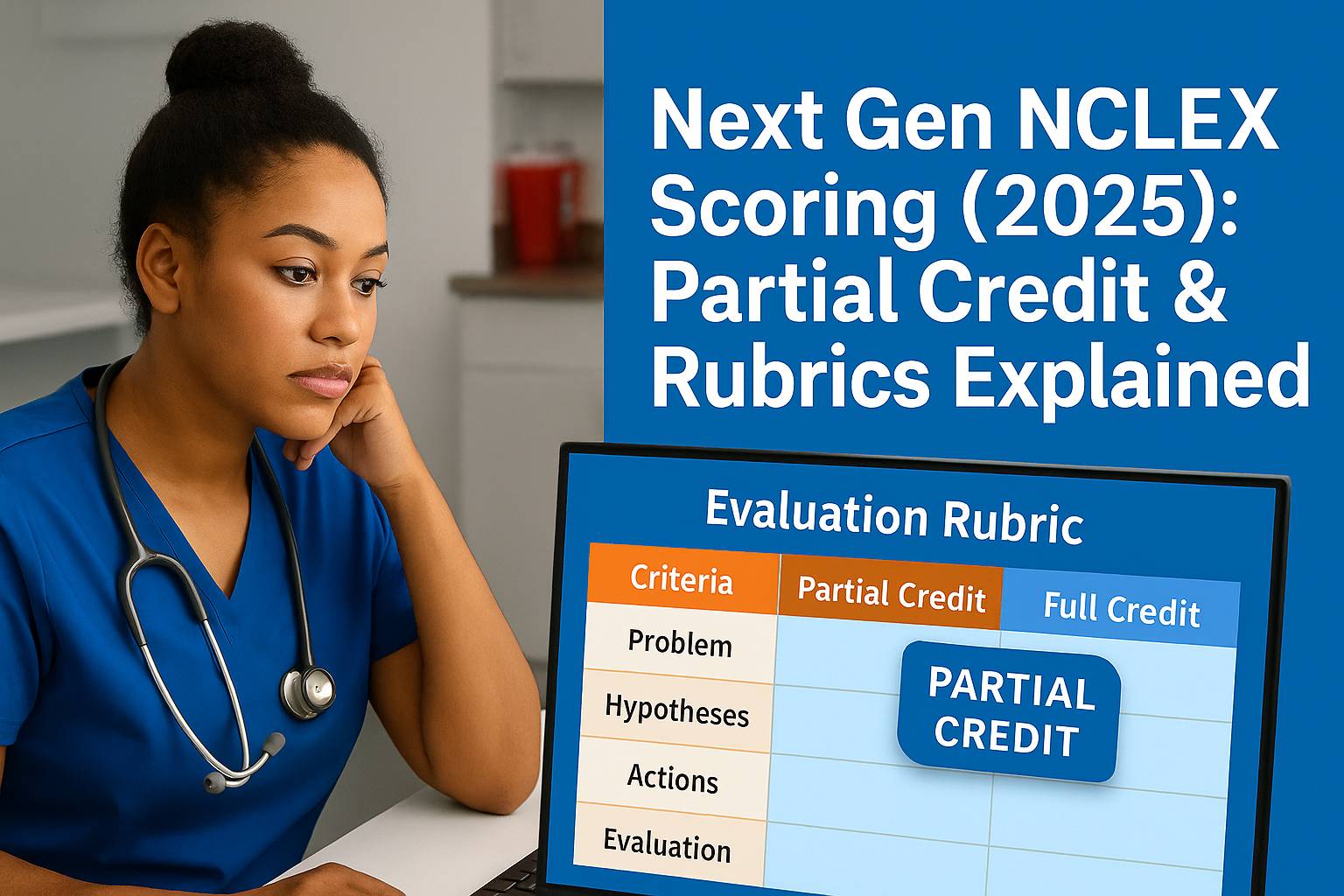
Scoring: You can earn points on each step, even if another step isn’t perfect.
2) Bow-Tie items
-
Three required fields: Problem, Actions (2), and Monitoring Parameters (2).
-
Partial credit: Points assigned per correctly matched field. Missed fields don’t erase correct ones.
3) Matrix/Multiple Response (row-by-row)
-
You evaluate each row (e.g., medication/lab/cue) as True/False or Safe/Unsafe.
-
Partial credit: Rows score independently; one mistake in a row doesn’t eliminate points from other rows.
4) Drop-Down Rationale / Cloze
-
Drop-downs inside a note or rationale (e.g., “because” statements).
-
Partial credit: Each correctly chosen drop-down earns a fraction of total credit.
5) Drop-Down Table
-
Choose the right cell for each variable (e.g., fluid rate, med dose, isolation type).
-
Partial credit: Scored by column/row or cell, depending on the prompt.
6) Highlight Text
-
Select only the relevant phrase(s) in a chart or narrative.
-
Partial credit: Points for required highlights; extra/irrelevant highlights reduce or negate credit for that segment.
7) Trend items
-
Compare serial vitals/labs to decide improving vs deteriorating vs stable.
-
Partial credit: Correct classification and correct next safety step each carry credit.
What “partial credit” really means
NGN uses polytomous scoring models. In practice that means:
-
Independent elements (rows, fields, drop-downs) earn credit separately.
-
No “all-or-nothing” on most NGN items—except where the task explicitly requires it.
-
Over-selecting (e.g., Highlight Text) can reduce/void credit for that element, so be precise.
-
Near-miss selections (clinically close but not correct) typically earn less or no credit—prioritize safety-first options.
10 ways to capture more points on NGN
-
Think row-by-row. In matrices, judge each row independently.
-
Anchor every pick to a cue. Ask: Which cue justifies this choice?
-
Name the biggest risk first. Airway/Breathing/Circulation before everything else.
-
Prioritize new/worsening cues. Trends that signal deterioration come first.
-
Use “what changes the outcome now?” Avoid nice-to-have education while a safety threat is active.
-
Bow-Tie = Problem → Actions → Monitoring. Don’t skip monitoring.
-
Highlight sparingly. Select only the exact phrase(s) that change decisions.
-
Medication logic: Confirm indication, contraindications, vitals/labs, and time-sensitive parameters before “administer”.
-
Document last. Stabilize the patient; documentation follows.
-
Finish every element. Even partial certainty can earn partial points.
Mini-practice (with rationales)
A) Trend/Action (partial-credit style)
You review a client’s AM labs: K⁺ 5.9 (↑ from 4.6 yesterday), ECG shows peaked T waves, mild weakness.
-
Classify: Deteriorating ✅
-
Best next action (choose 1):
-
Place on cardiac monitor ✅
-
Educate on low-potassium diet ❌ (not priority)
-
Administer routine multivitamin ❌
Rationale: Hyperkalemia with ECG changes is a cardiac risk → monitoring + provider notification and therapies follow; education is not first.
-
B) Bow-Tie (Problem → Actions → Monitoring)
Cues: Temp 39.2 °C, productive cough, crackles RLL, RR 26, SpO₂ 90% RA.
-
Problem: Impaired gas exchange / pneumonia ✅
-
Actions (2): Elevate HOB; Initiate oxygen per protocol ✅
-
Monitoring (2): SpO₂ and breath sounds ✅
Rationale: Interventions improve oxygenation and ventilation; monitoring checks response.
How to read your (unofficial) performance
-
Expect strengths/needs by Client Needs and sometimes by CJM step.
-
Focus remediation on missed steps (e.g., great at recognizing cues, weaker at prioritizing hypotheses).
Study pathway (internal resources)
-
NGN item types explained: How Is the Next Gen NCLEX Different? →
-
Row-by-row scoring practice: Matrix Multiple Response Strategy →
-
Bow-Tie practice: Bow-Tie Items — Problem, Actions, Monitoring →
-
First-action logic: Analysis & Prioritization — Turn Cues into the Right First
Authoritative references (for deeper reading)
Your next step
Practice exactly how the exam scores you. Work through NGN case studies with row-by-row, field-by-field thinking and collect partial credit wherever possible.
Start practicing NGN scoring now: visit Nurseclex
for updated case studies, bow-ties, matrices, and rationales.